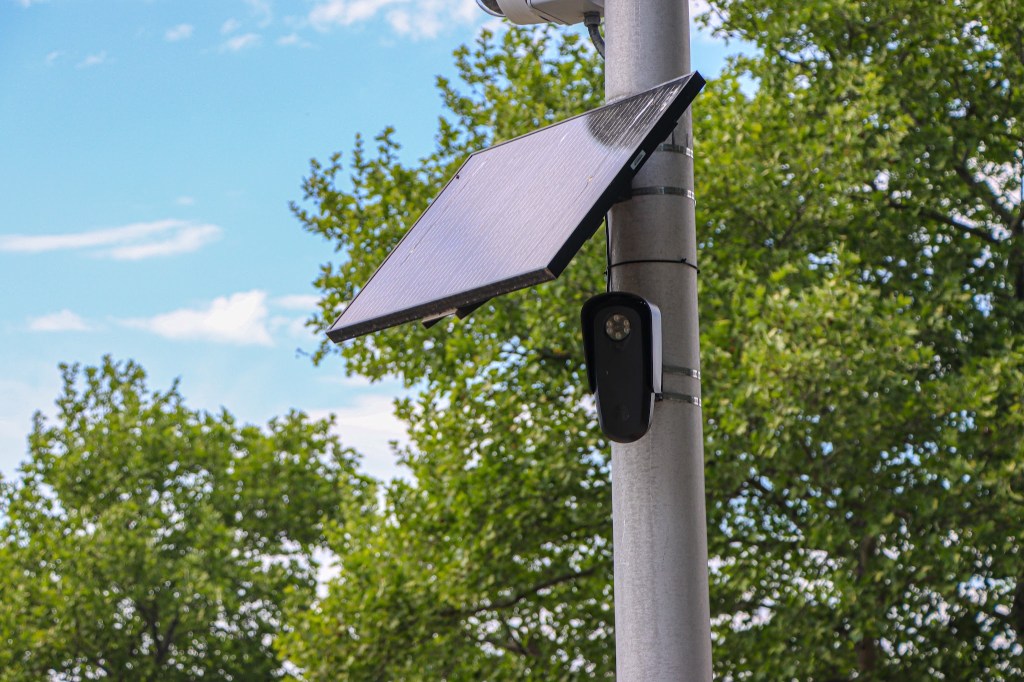
A Flock Safety license plate reader mounted on campus is part of a network that captures and stores data on vehicles entering and leaving the area.
By: Kaylah Ussin
Nearly every car driving onto or leaving Norfolk State University passes by a solar-powered camera mounted near campus entry and exit points.
The devices are automated license plate readers (ALPR), capturing photos of every passing vehicle’s license plate and storing it in a database as part of a broader law enforcement network shared by agencies across Virginia.
Seventeen of these devices — owned by Flock Safety, a U.S.-based surveillance technology company — are positioned around Norfolk State’s campus. In Hampton Roads, home to three public universities, Norfolk State is the only public university — and the only HBCU — encircled by them. By comparison, mapping data shows about five cameras within a few blocks of Old Dominion University and roughly two near Christopher Newport University’s entrances.
“Every time you come on and off that campus in a vehicle, you are being tracked, and your data is being stored,” said Steven Keener, a criminology professor at Christopher Newport University and lead author of a January study that found the area around Norfolk State University has the highest concentration of ALPRs in the city.
The study’s map also shows these publicly funded cameras are not evenly distributed across Hampton Roads. Of the region’s 600-plus Flock cameras, most are positioned in areas with higher Black populations and higher poverty rates.
“Another way of putting this,” the study states, “is that surveillance operates as a default condition in Black and high-poverty neighborhoods, but as an optional or even absent condition in White and low-poverty neighborhoods.”
Campus police confirmed the university entered into a contract with Flock Safety in October 2023, with cameras installed around the spring of 2024. The system monitors vehicle entry points, can generate real-time alerts for flagged vehicles, and retains data for about 21 days under Virginia law.
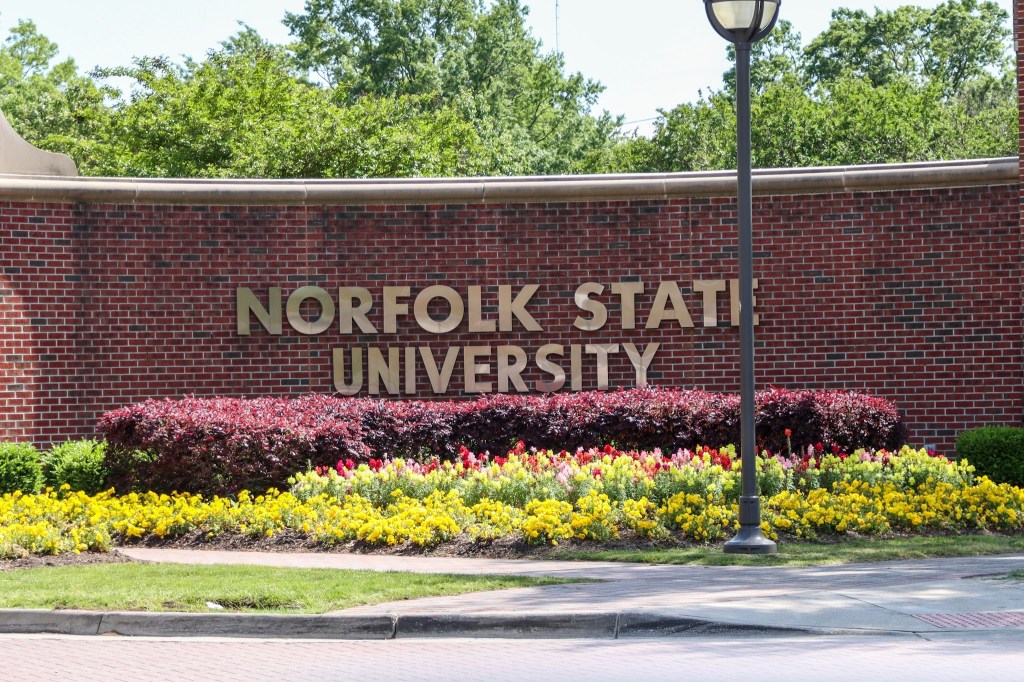
Main entrance to the Norfolk State University campus.
The agency said the cameras can record license plates, along with vehicle make, model, and color, but do not use facial recognition technology. Some images captured by these readers can also include distinguishing features such as dents and bumper stickers. The cloud database that stores the information is operated by Flock Safety.
Addressing the number of cameras surrounding campus, Norfolk State University Police Chief Brian Covington said the cameras are not placed based on the racial makeup of the area but are intended to deter crime and support investigations.
“If Norfolk State were positioned over at ODU I would certainly ask for the same amount of cameras,” Covington said.
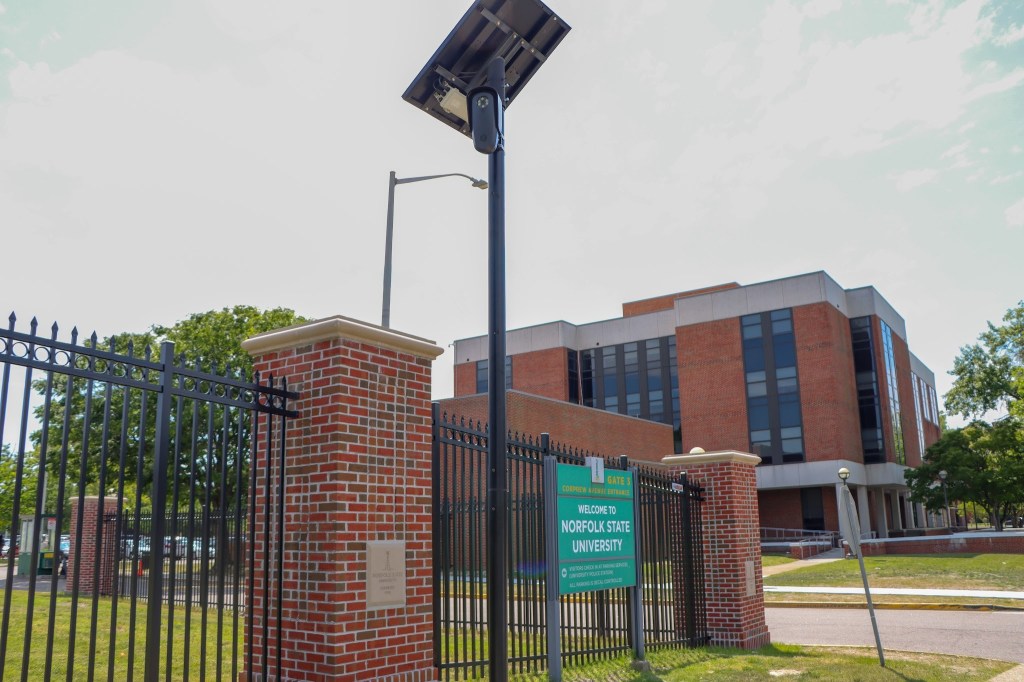
Image of a Flock camera near the entrance to Gate 3 of the NSU campus.
The use of ALPR devices is part of a broader debate over privacy and Fourth Amendment protections, which guard against unreasonable searches and generally require probable cause for certain forms of surveillance. Among other things, it helps ensure that people can move about their daily lives — including on a college campus — without being subject to undue searches by police.
Across Virginia, that debate is playing out locally, with organizing efforts in Richmond, Harrisonburg, Chesterfield, and across Tidewater pushing officials to reconsider or cancel their use, while Charlottesville and Staunton have already ended their contracts.
In March, students at the College of William & Mary voted in favor of a referendum on the Spring 2026 election ballot calling for the university and campus police to end their contract with Flock Safety.
A federal case in Norfolk is currently on appeal, challenging the city’s use of license plate readers over concerns the system may violate constitutional protections and make it difficult to drive without being tracked. A complaint in the case states that, over a nearly five-month period, cameras logged one plaintiff’s location 849 times.
In its opinion, the lower court ruled in favor of the City of Norfolk, finding that the city’s ALPR system had not been shown to violate the Fourth Amendment through comprehensive tracking of individuals over time.
Michael Soyfer, an attorney with the Institute for Justice and one of the lead attorneys for the plaintiffs, told The Spartan Echo that “law-abiding Norfolk residents shouldn’t have to go about their day knowing that their movements are being tracked and stored,” arguing the case raises issues that could be reconsidered on appeal in light of rulings from higher courts that warn about the risks of broad surveillance systems.
Prior to a law that took effect on July 1, 2025, Virginia did not have a statewide framework governing how law enforcement agencies used ALPR systems.
The new law now requires law enforcement to use ALPR data for criminal violations, active investigations involving missing persons or human trafficking, and notifications related to stolen vehicles. Virginia law also requires that all access be logged and audited.
Additionally, the law requires local agencies to notify the public about their use of ALPR technology, though compliance has varied across the state.
A January report from the Virginia State Crime Commission (VSCC) found that about two-thirds of the 159 responding agencies said they had taken at least one step to inform the public about their use of ALPR, while the remaining 55 who self-reported said they had not.
At the time The Spartan Echo began its reporting, a review of several sections of the Norfolk State University Police Department website did not find mention of the camera system. After the newspaper raised questions about the readers, the department distributed a campus-wide email and added a page to the university site outlining their use and role in campus safety.
The department did confirm that Norfolk State Police’s license plate readers contribute images to the regional database that allows City of Norfolk Police and other state agencies to share and access information during investigations.
Covington said that the database has assisted the department in solving crimes, including shootings in and around campus.
Virginia prohibits law enforcement agencies from freely sharing system data with out-of-state databases or federal agencies. At the same time, the law allows data to be shared in limited, state-regulated circumstances.
But in the past year, revelations about how the system has been used have shown the potential for ongoing access by federal agencies and for immigration-related searches conducted through Virginia’s Flock network.
Flock addressed concerns about ICE access in its public statements.
“ICE does not have direct access to Flock cameras, systems, or data, unless the agencies that control their data expressly and deliberately allow it,” the company has stated.
The company also said that it “takes legal scrutiny of public safety and security technology seriously” and remains focused on supporting “lawful, transparent, and responsible” use of the technology.
Covington emphasized that misuse within his department would carry consequences.
“Any of my officers that misuse technology will be reprimanded, and if it calls for termination, they will be terminated,” he said.
Keener, who called for the readers’ complete removal, said the risks of the technology outweigh its benefits, given growing public concerns about exposure to unlawful monitoring despite restrictions in place.
“The guardrails are only as good as the people willing to follow them,” said Keener.
He also suggested that when those restrictions are not followed, the impacts — much like the uneven placement of the cameras themselves — are not evenly distributed across communities.
“The places that are most surveilled are obviously most at risk for that.”
If you have questions or comments about the presence and use of Flock cameras on campus, please contact The Spartan Echo: nsuspartanecho@gmail.com.