
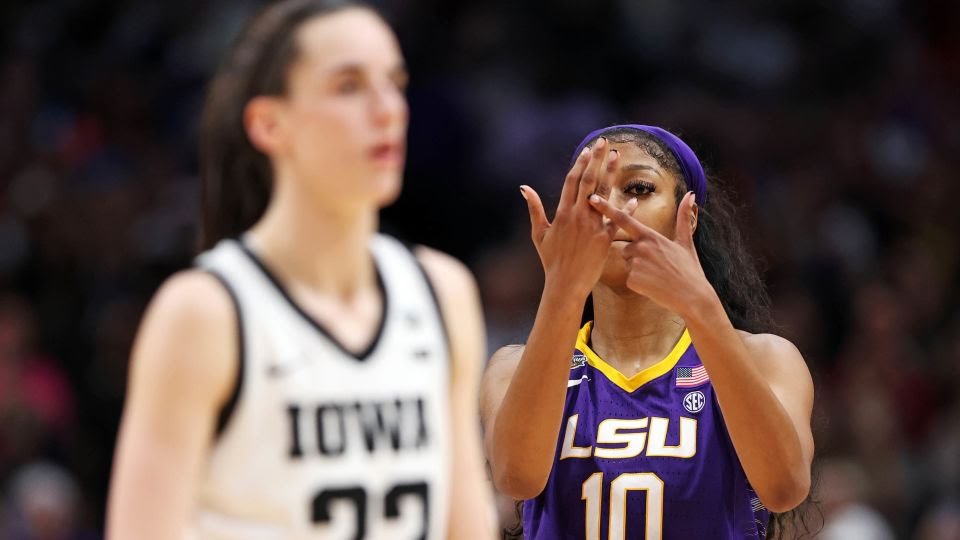
Louisiana State University (LSU) sophomore basketball player, Angel Reese, helped lead the Tigers to the National Collegiate Athletic Association (NCAA) title. In the closing minutes of the game, Reese followed Iowa star Caitlin Clark around the court and waved her hand in front of her face, a taunt popularized by professional wrestler John Cena. She then pointed to her ring finger in reference to a championship ring.
Her actions came under scrutiny on social media and sports talk, with some criticizing her for poor sportsmanship.Some say it was a double standard because Clark did not receive similar backlash for making the gesture two games earlier. Reese is Black and Clark is white. What do you think? Was Reese outlined to do this? Did she go too far?
Angel Reese’s actions are an example of typical game time trash talk. The media is trying to deter Reese’s character by calling her “classless” and “disrespectful.” Meanwhile Reese’s actions equate to those of Caitlin Clark, the “victim” of Reese’s taunting. Clark has been provoking throughout the entire tournament. Clark had used the “you can’t see me” movement during multiple games including South Carolina and Louisville.
Clark did not receive any backlash during these games due to “competitive play”. After the championship, Reese was asked what her reasoning was for her actions, “I don’t take disrespect lightly, she disrespected Alexis and my SEC girls at South Carolina,” Reese responded. An obvious double standard is used against Angel Reese, due to the media feeling sorry for Caitlyn Clark.
Trash talk is something that typically takes place at every professional game, on multiple occasions there have been collegiate and professional athletes whose actions were considered worse than what Reese did at the National Championship.
A few instances occurred in 2017 when the University of Oklahoma Sooners won, Baker Mayfield put their school flag on the Ohio State field. Also during this time at Duke University, Grayson Allen had a reputation as a “dirty player”. Throughout many games, he was observed tripping and pushing opponents.
More recently, during the NCAA women’s tournament, Hall of Fame quarterback Brett Farve has been charged with a number of offenses. The claims are based on his alleged participation in the Mississippi welfare scheme, which involved the theft of about $77 million. Although these allegations were made, the media paid little to no attention to them. Angel Reese’s hatred in the media thrusted her into the spotlight for several days before Clark herself downplayed the taunt.
The media constantly criticizes black athletes more harshly. Issues with Reese were present before the NCAA women’s tournament, before the start of the women’s season. Reese reportedly blasted her opponents too much, according to coaches. When in reality this happens in all professional sports. The tales and the scoffing are what keep the game interesting.
On an average day, the NBA taunts almost every possession. James Harden’s stir the pot motion, Carmelo Anthony’s signature “three to the head” and Kevin Durant’s “too small” gesture are well-known and popular crowd-pleasers. All three of these players are recognized as strong trash talkers, and their distinctive taunting makes them marketable.
Despite each of their individual triumphs, Reese and Clark’s conflict remained the main topic of discussion. With some taking sides and others urging both players to move on, fans and commentators questioned the incident and the players’ behavior.
Reese and Clark’s argument ultimately serves as a reminder of the enormous expectations and emotions that come with participating in high-level athletics. Both athletes surely have promising futures ahead of them, but their confrontation serves as a lesson on the value of sportsmanship and respect both on and off the court.
Fans can only hope that Reese and Clark will both take what they have learned from it and use it to advance both as sportswomen and people.

 Spartan Echo