
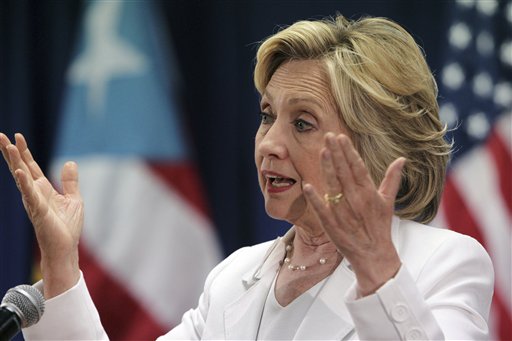
SAN JUAN, Puerto Rico (AP) — Puerto Rico’s financial crisis looms over Friday campaign appearances by Democrat Hillary Rodham Clinton and Republican Marco Rubio, two presidential contenders with sharply different positions on a key issue for Puerto Rican voters whose influence is growing in U.S. politics.
The U.S. territory must find its own way to get its financial house in order, Rubio wrote in an op-ed published in Spanish Friday in El Nuevo Dia, Puerto Rico’s largest newspaper. The Florida Republican opposes efforts to allow Puerto Rico to use bankruptcy laws to deal with a staggering $72 billion debt.
Rubio will appear at an afternoon fundraiser and rally shortly before Clinton, the Democratic front-runner, attends a round table discussion about the island’s health-care problems. It’s unclear if Clinton will address directly her support for giving Puerto Rico bankruptcy protection, which some Republicans describe as a bailout.
“The reality is that Puerto Rico’s leaders must lead and do the difficult but essential work of cutting spending, reining in out-of-control big government and eliminating job-killing policies, including scores of new tax increases,” Rubio wrote.
Clinton’s planned focus on health care, instead of the island’s financial crisis, sparked criticism ahead of her afternoon appearance.
Local Rep. Jose Enrique Melendez, of Puerto Rico’s pro-statehood party, demanded that all presidential candidates who visit the U.S. territory publicly state their opinion regarding the island’s future political status.
“It’s time that Puerto Ricans start demanding respect,” he said, and later criticized Clinton for not addressing Puerto Rico’s political status further.
“This sends a clear message on where she’ll stand regarding Puerto Rico’s problems if she’s elected,” Melendez said, “especially when the island is going through an economic crisis that has sparked a massive migration to the 50 states.”
Residents of Puerto Rico are U.S. citizens but can’t vote for president. Yet the U.S. territory holds primary contests for both parties that give candidates a chance to connect with Hispanic voters across the nation.
Five million Puerto Ricans live on the U.S. mainland, including nearly 1 million in the key swing state of Florida, and they care about what happens back on the island.
Clinton soundly defeated then-Sen. Barack Obama in Puerto Rico’s 2008 primary.
Former Florida Gov. Jeb Bush visited in April before announcing his Republican presidential campaign and was warmly received as he praised the contributions of immigrants and endorsed statehood, a long-running issue for generations of Puerto Ricans, many of whom feel like second-class citizens because of their limited voting rights.
Martin O’Malley, a Democrat and former Maryland governor who visited last month, pledged to fight for equal treatment, noting that Puerto Rico gets lower Medicaid and Medicare reimbursement rates than the mainland, an issue also on Clinton’s agenda.
The parade of presidential hopefuls to the territory speaks to the growing power of Puerto Rican voters on the mainland, especially in Florida, the top destination for those fleeing the island’s 12 percent unemployment rate and nine-year economic slump. The governor declared the massive public debt unpayable and that it needs restructuring.
“It’s an issue that hits close to home whether you live here or on the island,” said Viviana Janer, 43, a Florida Democrat from Kissimmee in central Florida. She was the winner among five candidates — all Puerto Ricans — who competed last year for a seat on the Osceola County Commission.
The arrival of more “Boricuas,” the term Puerto Ricans affectionately call themselves, is changing the political equation in Florida, say political observers.
“These new Puerto Rican voters now make it possible for Democrats to win Florida without Blue Dog Democrats,” said Lance deHaven-Smith, a Florida State University political science professor, referring to a phrase describing Southern conservative Democrats.
Another factor, he said, is that Cuban-American voters, who for decades had been the state’s dominant Hispanic voting bloc, are now split among the major parties.
Indeed, the Pew Hispanic Center reports that Cuban-Americans still represent the largest bloc of all registered Hispanic voters in Florida, 31 percent, but Puerto Ricans are right behind them at 29 percent. A quarter century ago, Cuban-Americans made up about half the state’s Hispanic voters.
In the 2012 election, 71 percent of Hispanics nationally voted to re-elect Obama, but only 60 percent in Florida did, exit polls found.
Historically, Puerto Ricans have sided with Democrats and are likely to remain loyal to the left, said deHaven-Smith. “I don’t think they are open to the Republican Party.”
But Republicans say they do see an opening, at least with recent arrivals, and have been going into Puerto Ricans communities for several years to woo potential voters.
Copyright 2015 The Associated Press. All rights reserved. This material may not be published, broadcast, rewritten or redistributed.
 Spartan Echo