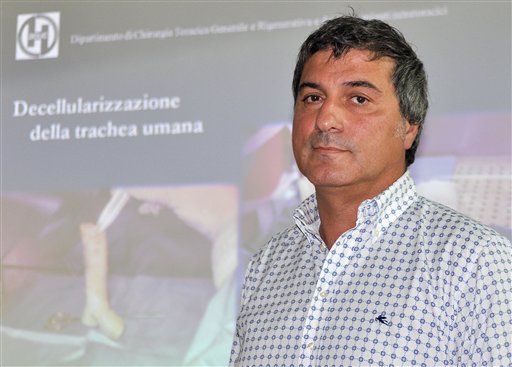
LONDON (AP) — Sweden’s Karolinska Institute says a leading stem cell scientist accused of unethical behavior has been cleared of scientific misconduct though he sometimes acted without due care.
In a statement released on Friday, the university said complaints leveled against Dr. Paolo Macchiarini — who has created wind pipes using patients’ stem cells — did not qualify as scientific misconduct, overturning a previous investigation in May which found him guilty.
After examining further documents submitted by Macchiarini, Karolinska’s vice-chancellor Anders Hamsten concluded there were flaws in Macchiarini’s work “but nothing that can be considered scientific misconduct.” The previous investigation had claimed, among other things, that Macchiarini “selectively described” certain minor problems in patients while omitting serious complications.
“To have been falsely accused of serious misconduct is every researcher’s nightmare,” Macchiarini said in an email. He said the accusations were extremely damaging to him and the field of regenerative medicine; the Swedish Research Council froze his grants in June.
Macchiarini has been instructed to submit corrected information to the journals that published some of his work to clarify the mistakes identified by the university’s inquiry.
Macchiarini said he would speak with Karolinska about immediately ensuring the reinstatement of his research grants. He and colleagues have developed a novel technique of seeding either donated or synthetic wind pipes with stem cells of patients to prevent rejection and are now expanding their work to include other organs.
“I feel it is extremely important that public confidence is restored in this field now,” he said. “It is only through the trust of present patients willing to take part in experimental surgeries that patients of the future will have a chance to benefit.”
Copyright 2015 The Associated Press. All rights reserved. This material may not be published, broadcast, rewritten or redistributed.
Summary
| Date: | 8/28/2015 6:34 AM |
| Slug: | AP-EU-MED-Stem-Cell-Scientist-Cleared |
| Headline: | Leading stem cell scientist cleared of misconduct charges |
| Source: | AP |
| Byline: | MARIA CHENG, AP Medical Writer |
| Copyright Holder: | AP |
| Priority: | r (4) |
| With Photo: | |
| Dateline: | LONDON |
| Editors’ Note: | Eds: Adds quotes from scientist, byline, photo. AP LON109. With AP Photos. |
| Word Count: | 282 |
| File Name (Transref): | V0882 LON109-0730101248 |
| Editorial Type: | |
| AP Category: | i |
| Format: | bx |

Edit Mode : Cancel
In a statement released on Friday, the university said complaints leveled against Dr. Paolo Macchiarini — who has created wind pipes using patients’ stem cells — did not qualify as scientific misconduct, overturning a previous investigation in May which found him guilty.
After examining further documents submitted by Macchiarini, Karolinska’s vice-chancellor Anders Hamsten concluded there were flaws in Macchiarini’s work “but nothing that can be considered scientific misconduct.” The previous investigation had claimed, among other things, that Macchiarini “selectively described” certain minor problems in patients while omitting serious complications.
“To have been falsely accused of serious misconduct is every researcher’s nightmare,” Macchiarini said in an email. He said the accusations were extremely damaging to him and the field of regenerative medicine; the Swedish Research Council froze his grants in June.
Macchiarini has been instructed to submit corrected information to the journals that published some of his work to clarify the mistakes identified by the university’s inquiry.
Macchiarini said he would speak with Karolinska about immediately ensuring the reinstatement of his research grants. He and colleagues have developed a novel technique of seeding either donated or synthetic wind pipes with stem cells of patients to prevent rejection and are now expanding their work to include other organs.
“I feel it is extremely important that public confidence is restored in this field now,” he said. “It is only through the trust of present patients willing to take part in experimental surgeries that patients of the future will have a chance to benefit.”

 Suggested
  Related
 Spartan Echo